Every online shopper makes a split-second judgment when they land on your store: Can I trust this website with my money and personal information? That question, answered consciously or subconsciously, determines whether they buy or bounce. Ecommerce trust signals are the visual cues, policies, and design elements that tip that decision in your favor.
In 2026, with fraud attempts rising and consumer skepticism at an all-time high, trust is no longer a nice-to-have — it is the foundation of conversion. According to the Baymard Institute, 19% of cart abandonments are directly caused by shoppers not trusting the site with their credit card information. Edelman’s Trust Barometer reports that 71% of consumers say they will not buy from a brand they do not trust, regardless of price.
This guide breaks down 18 proven ecommerce trust signals organized into six categories. Each one is backed by data, illustrated with real-world examples, and actionable enough to implement this week. Whether you are running a new direct-to-consumer brand or optimizing an established store, these elements will measurably increase buyer confidence and conversions.
1. Visual Trust Signals: Security Cues That Reassure at a Glance
Visual trust signals are the fastest-acting elements on your site. Shoppers scan for them before reading a single word of copy. They answer the most primal question in ecommerce: Is it safe to enter my payment details here?
| # | Trust Signal | Category | Impact | Best Placement |
|---|---|---|---|---|
| 1 | SSL/HTTPS | Visual | 🔴 Critical | Site-wide |
| 2 | Payment icons | Visual | 🟡 High | Footer + checkout |
| 3 | Security seals | Visual | 🟡 High | Checkout + product |
| 4 | Customer reviews | Social | 🔴 Critical | Product pages |
| 5 | Testimonials | Social | 🟡 High | Homepage + landing |
| 6 | User counts | Social | 🟢 Medium | Homepage |
| 7 | Media logos | Social | 🟡 High | Homepage + about |
| 8 | Return policy | Policy | 🔴 Critical | Product + checkout |
| 9 | Shipping info | Policy | 🟡 High | Product + cart |
| 10 | Money-back guarantee | Policy | 🟡 High | Checkout + hero |
| 11-13 | Certs / Awards / Endorsements | Authority | 🟢 Medium | Homepage + about |
| 14-16 | About / Team / Address | Transparency | 🟡 High | Footer + about |
| 17-18 | Design quality / Speed | UX | 🔴 Critical | Site-wide |
Trust Signal #1: SSL Certificate and HTTPS Padlock
An SSL certificate encrypts data between the browser and your server. In 2026, HTTPS is table stakes — Google Chrome actively warns users when a site lacks it, and most browsers display a visible padlock icon in the address bar. Yet the trust impact goes beyond the padlock. A GlobalSign survey found that 84% of online shoppers would abandon a purchase on a site without HTTPS.
What to do:
- Ensure your entire site (not just the checkout) runs on HTTPS.
- Use an Extended Validation (EV) certificate if you sell high-ticket items — it displays your company name in the address bar on supported browsers.
- Check for mixed content warnings where HTTP resources load on HTTPS pages, which can break the padlock indicator.
Trust Signal #2: Payment Method Icons
Displaying recognizable payment logos — Visa, Mastercard, American Express, PayPal, Apple Pay, Google Pay, Shop Pay — signals legitimacy and convenience simultaneously. A study by ConversionXL found that payment badges increased perceived trustworthiness by 42% in user testing sessions.
Place payment icons in three locations: the footer (site-wide reassurance), the product page (near the add-to-cart button), and the checkout page (confirmation before committing). Only display payment methods you actually accept — showing logos you do not support erodes trust rather than building it.
Trust Signal #3: Security Seals and Trust Badges
Third-party trust badges from Norton, McAfee Secure, TrustedSite, or the Better Business Bureau act as borrowed credibility. The Baymard Institute tested which seals consumers trust most and found that Norton and McAfee badges outperformed lesser-known alternatives by a wide margin, largely because of brand recognition.
However, placement matters. Security seals placed near form fields and the checkout button perform significantly better than those buried in the footer. A/B tests by Blue Fountain Media showed a 42% increase in conversions when a trust seal was placed directly next to the submit button on a lead generation form. The same principle applies to ecommerce checkout flows.
“Trust badges work because they transfer established credibility from a known entity to an unknown one. The key is choosing badges your specific audience recognizes — a Norton seal resonates differently in North America than in Southeast Asia, where local payment trust marks may carry more weight.”
2. Social Proof: Letting Your Customers Sell for You
Social proof is arguably the most powerful category of ecommerce trust signals. It leverages a fundamental psychological principle: when people are uncertain, they look to others for guidance. In ecommerce, this translates directly into revenue. BrightLocal reports that 87% of consumers read online reviews before making a purchase, and products with reviews convert at a rate 270% higher than those without.
Trust Signal #4: Customer Reviews and Ratings
Product reviews are the single most influential trust signal for purchase decisions. They provide unfiltered, experience-based information that no amount of marketing copy can replicate. Spiegel Research Center found that displaying reviews can increase conversion rates by up to 380% for higher-priced products, where the perceived risk is greatest.
Best practices for maximizing review impact:
- Display negative reviews alongside positive ones. A perfect 5.0 rating actually reduces trust. The sweet spot for conversion is between 4.2 and 4.7 stars, according to Northwestern University research.
- Include photos and videos from customers. User-generated visual content increases trust because it proves real people bought and used the product.
- Show verified purchase badges. Platforms like Yotpo, Judge.me, and Trustpilot can confirm the reviewer actually bought the item.
- Respond to negative reviews publicly. How you handle criticism tells potential buyers more about your brand than a hundred five-star reviews.
For a deeper dive into optimizing how reviews appear on your listings, explore our guide to product page best practices.
Trust Signal #5: Customer Testimonials
While reviews are product-specific, testimonials are brand-level endorsements. They work best on landing pages, the homepage, and about pages. The most effective testimonials include the customer’s full name, photo, location, and specific results. Vague praise like “Great company!” carries almost no persuasive weight. A testimonial that reads “We switched to [Brand] and reduced our return rate by 34% in the first quarter” is concrete, credible, and compelling.
Video testimonials outperform text by a significant margin. Wyzowl reports that 79% of consumers have been convinced to buy a product or service by watching a brand’s video, and customer testimonial videos rank among the most persuasive formats.
Trust Signal #6: User Counts and Activity Indicators
Numbers tell a story of popularity and reliability. Displaying metrics like “50,000+ customers served,” “1.2 million orders shipped,” or “Rated 4.8 by 12,000+ buyers” provides immediate social proof at scale. Real-time activity notifications — such as “Sarah from Austin just purchased this item 12 minutes ago” — create urgency and social validation simultaneously.
Use these indicators honestly. Fabricating numbers or using fake activity notifications will backfire catastrophically if discovered, and in 2026, consumers and regulators are increasingly sophisticated at detecting deception. The FTC has issued updated guidance on fake reviews and endorsements with significant penalties for violations.
Trust Signal #7: Media Logos and Press Mentions
“As seen in” or “Featured in” sections displaying logos from recognized publications — Forbes, TechCrunch, Vogue, The New York Times — borrow authority from established media brands. This is particularly effective for newer brands that lack extensive review histories. Even a brief mention in a well-known outlet can be leveraged into a powerful trust signal.
Place media logos on the homepage, ideally above the fold or just below the hero section. Keep the display clean and uncluttered — four to six logos in a single row typically performs best. Link each logo to the actual article or mention for added credibility.
3. Policy Trust: Reducing Perceived Risk Through Clear Commitments
Every purchase involves risk: the product might not fit, it might not match the photos, or it might arrive damaged. Policy trust signals directly address these fears by shifting risk from the buyer to the seller. When done well, they eliminate the last psychological barrier between consideration and conversion.
Trust Signal #8: Clear Return and Refund Policy
A generous, clearly communicated return policy is one of the most effective conversion drivers in ecommerce. UPS research found that 73% of shoppers say the returns experience influences their decision to buy from a retailer again, and Narvar reports that 49% of shoppers proactively check the return policy before purchasing.
Your return policy should be:
- Easy to find. Link it in the header, footer, product pages, and cart page.
- Written in plain language. Avoid legal jargon. If your policy requires a law degree to parse, it signals that you are trying to avoid honoring it.
- Generous in timeframe. A 30-day window is standard; 60 or 90 days signals extreme confidence in your product. Counterintuitively, longer return windows often result in fewer returns due to the endowment effect.
- Specific about process. Detail exactly how to initiate a return, who pays shipping, and how quickly refunds are processed.
Trust Signal #9: Shipping Transparency
Unexpected shipping costs are the number one reason for cart abandonment, cited by 48% of shoppers according to Baymard Institute research. But shipping transparency goes beyond displaying costs early. It includes estimated delivery dates, carrier information, and tracking capabilities.
Display shipping information prominently on product pages — not just at checkout. A simple banner stating “Free shipping on orders over $75 | Arrives in 3-5 business days” addresses two trust concerns at once: hidden costs and delivery uncertainty. If you offer same-day or next-day shipping, make it a headline feature — speed is a powerful trust signal in itself.
Trust Signal #10: Money-Back Guarantees
A money-back guarantee is a return policy’s bolder, more confident sibling. It goes beyond “you can send it back” to “we are so confident you will love this that we will refund you completely if you don’t.” The psychological impact is significant: it frames the purchase as risk-free.
Visual presentation matters. A guarantee badge or seal — a circular emblem with text like “100% Money-Back Guarantee” or “60-Day Risk-Free Trial” — performs better than text alone. Place it near the add-to-cart button and on the checkout page. VWO case studies have documented conversion increases of 15-30% when a visible guarantee badge is added to product pages.
4. Authority Trust: Leveraging External Credibility
Authority trust signals demonstrate that recognized institutions, experts, or industry bodies have validated your brand. Unlike social proof (which comes from peers), authority trust comes from entities perceived as having superior knowledge or standards. It is particularly effective for products where expertise matters — health supplements, financial services, technical equipment, and premium goods.
Trust Signal #11: Industry Certifications
Certifications signal that your products or processes meet established standards. Examples include organic certifications (USDA Organic, EU Organic), safety certifications (UL, CE marking), sustainability certifications (B Corp, Fair Trade), and industry-specific credentials (GMP for supplements, OEKO-TEX for textiles).
Display certification logos on relevant product pages and in your footer. For certifications that are less widely recognized, include a brief explanation of what they mean and why they matter. A tooltip or expandable section that says “OEKO-TEX Standard 100: Tested for harmful substances. Every component of this product has been tested and certified safe” adds context that enhances the trust signal’s impact.
Trust Signal #12: Awards and Recognition
Industry awards, “best of” designations, and competitive rankings provide third-party validation that your product excels. Whether it is a Good Housekeeping Seal, a Webby Award, or an industry-specific accolade, awards differentiate you from competitors by introducing an element of objective evaluation.
Create a dedicated “Awards” section on your homepage or about page, and reference specific awards on the product pages they are relevant to. A skincare product page that displays “Winner — Allure Best of Beauty 2025” immediately elevates perceived quality.
Trust Signal #13: Expert Endorsements
Endorsements from recognized experts — dermatologists recommending skincare, sommeliers recommending wine, professional athletes endorsing fitness equipment — carry substantial weight because they imply informed evaluation. A Nielsen study found that expert endorsements are the third most trusted form of advertising, behind only recommendations from people you know and branded websites.
Present expert endorsements with the endorser’s credentials, photo, and specific quote. Generic attributions like “recommended by doctors” are weak; “Recommended by Dr. Sarah Chen, Board-Certified Dermatologist with 15 years of clinical experience” is specific, verifiable, and credible.
5. Transparency Signals: Showing the Humans Behind the Brand
In an era of faceless dropshipping operations and fly-by-night stores, transparency is a powerful differentiator. Showing who you are, where you operate, and what you stand for creates an emotional connection that purely transactional signals cannot match. Research from Label Insight reveals that 94% of consumers are more likely to be loyal to a brand that offers complete transparency.
Trust Signal #14: Comprehensive About Page
Your about page is one of the most visited pages on your site, yet it is frequently neglected. A well-crafted about page tells your brand’s origin story, explains your mission and values, and gives visitors a reason to choose you over Amazon. It should answer: Who founded this company and why? What problem are you solving? What do you believe in?
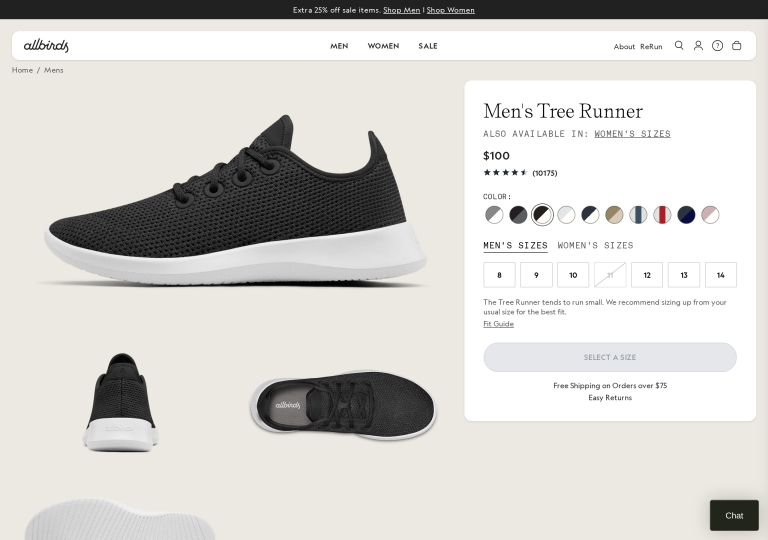
Brands like Patagonia, Allbirds, and Warby Parker have turned their origin stories into competitive advantages. Their about pages do not just explain what they sell — they articulate why they exist and what they stand for. This narrative approach builds emotional trust that transcends product features and pricing.
Trust Signal #15: Team Photos and Founder Visibility
Putting faces to your brand humanizes it. Team photos, founder bios, and behind-the-scenes content signal that real, accountable people stand behind the products. This is particularly important for small and mid-sized ecommerce brands competing against faceless marketplaces.
A Stanford Web Credibility Research study found that showing the people behind a website was one of the top factors influencing perceived credibility. Include team photos on your about page, feature your founders in email marketing, and consider adding short team member bios to your site. The goal is not to create a corporate directory — it is to demonstrate that real humans are responsible for the customer experience.
Trust Signal #16: Physical Address and Contact Information
Displaying a physical address, phone number, and email address signals permanence and accountability. It tells visitors: we are a real business that you can reach if something goes wrong. This is surprisingly rare among smaller ecommerce stores, which makes it a simple but effective differentiator.
Beyond a basic address listing, consider:
- An embedded Google Map showing your location.
- A phone number with business hours (a toll-free number adds additional credibility).
- Live chat availability — Kayako research shows that 51% of consumers are more likely to purchase from a site offering live chat.
- A comprehensive FAQ page that anticipates common questions and concerns.
If your CRO audit reveals that contact pages have high traffic but low engagement, your existing contact information may be insufficient or hard to find.
6. UX Trust: Design and Performance as Credibility
User experience trust signals are often overlooked because they are not discrete elements you can “add” to a page — they are systemic qualities of your entire site. However, their impact on perceived trustworthiness is enormous. Research from Stanford’s Persuasive Technology Lab found that 75% of users judge a company’s credibility based on their website’s design.
Trust Signal #17: Professional, Consistent Design
A professionally designed website signals investment, stability, and attention to detail. Conversely, a site with inconsistent fonts, pixelated images, broken layouts, or outdated design patterns triggers immediate skepticism. Shoppers unconsciously reason: if this company cannot invest in a professional website, can I trust them to handle my order correctly?
Key elements of trust-building design:
- Consistent visual language. Use a cohesive color palette, typography system, and spacing scale across every page.
- High-quality product photography. Invest in professional photos with multiple angles, lifestyle context, and zoom capability. Blurry or stock-looking product images are conversion killers.
- Error-free copy. Spelling mistakes, grammatical errors, and awkward phrasing undermine credibility instantly. Proofread everything.
- Modern, clean layout. Whitespace is not wasted space — it signals sophistication and makes content easier to consume.
If you are running on Shopify, a comprehensive Shopify store audit can identify design inconsistencies and UX friction points that silently erode trust across your entire storefront.
Trust Signal #18: Fast Loading Speed and Mobile Optimization
Site speed is a trust signal, a ranking factor, and a direct conversion lever. Google research shows that 53% of mobile visitors abandon a site that takes longer than three seconds to load. Every additional second of load time reduces conversions by approximately 7%, according to Akamai.
In 2026, mobile commerce accounts for over 72% of ecommerce traffic globally. A site that is not optimized for mobile is not just losing conversions — it is actively signaling to the majority of its visitors that their experience is an afterthought. Core Web Vitals, Google’s user experience metrics, now carry significant weight in both SEO rankings and user perception.
Critical performance benchmarks to target:
- Largest Contentful Paint (LCP): Under 2.5 seconds. This measures how quickly the main content loads.
- Interaction to Next Paint (INP): Under 200 milliseconds. This measures responsiveness to user interactions.
- Cumulative Layout Shift (CLS): Under 0.1. This measures visual stability — elements should not jump around as the page loads.
A fast, stable, mobile-optimized site does not just perform better — it feels more trustworthy. Speed communicates competence, and competence builds confidence.
Building a Trust Signal Strategy: Prioritization and Implementation
With 18 trust signals to consider, the temptation is to implement everything at once. Resist it. A cluttered page with dozens of badges, seals, and banners competing for attention can actually reduce trust by making your site look desperate. The goal is strategic placement of the right signals at the right moments in the buyer’s journey.
Prioritize by Impact and Effort
Start with the trust signals that address your biggest conversion barriers. If your analytics show high cart abandonment, focus on checkout trust signals: SSL indicators, payment icons, security seals, and clear return policies. If your bounce rate is high on product pages, prioritize reviews, guarantees, and professional photography.
A practical prioritization framework:
- Foundation (implement immediately): HTTPS, payment icons, clear return policy, contact information, mobile optimization.
- Growth (implement within 30 days): Customer reviews, shipping transparency, money-back guarantee, professional design audit.
- Authority (implement within 90 days): Certifications, expert endorsements, media logos, about page overhaul, team photos.
- Advanced (ongoing): Video testimonials, real-time activity indicators, user-generated content programs, site speed optimization.
Match Trust Signals to the Buyer Journey
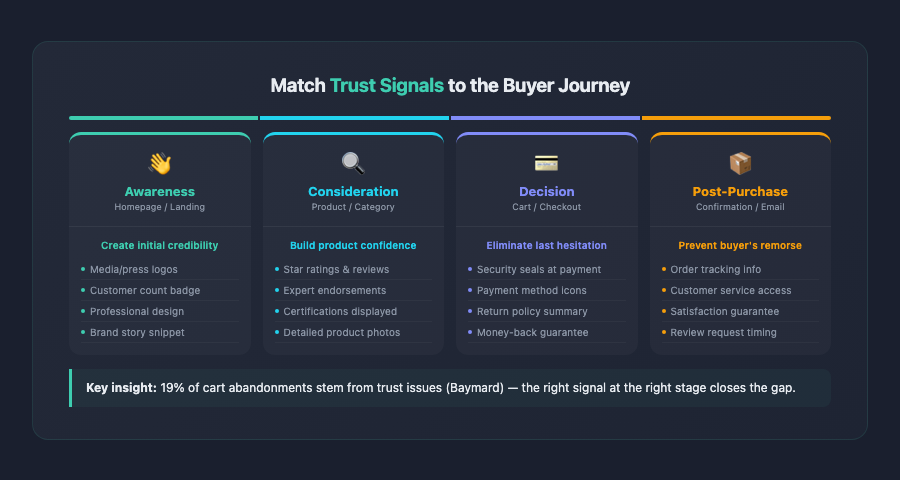
Different trust signals serve different stages of the purchase decision. Understanding this alignment prevents redundancy and maximizes impact:
- Awareness stage (homepage, landing pages): Media logos, user counts, brand story, professional design. These create initial credibility.
- Consideration stage (product pages, category pages): Reviews, ratings, expert endorsements, certifications, detailed product photography. These build product-level confidence.
- Decision stage (cart, checkout): Security seals, payment icons, return policy, money-back guarantee, shipping details. These eliminate last-minute hesitation.
- Post-purchase (order confirmation, email): Tracking information, customer service availability, satisfaction guarantees. These prevent buyer’s remorse and encourage repeat purchases.
Test, Measure, and Iterate
Trust signals are not immune to testing. What works for a luxury fashion brand may not work for a budget electronics store. A/B test individual elements — try different trust badge placements, compare review display formats, experiment with guarantee language. Track not just conversion rate but also metrics like time on page, add-to-cart rate, and checkout completion rate.
Our 276-point CRO checklist includes a dedicated trust signal audit section that walks you through evaluating each of these elements systematically across your entire storefront.
Common Trust Signal Mistakes to Avoid
Even well-intentioned trust-building efforts can backfire. Watch for these common pitfalls:
- Badge overload. Displaying ten trust badges creates visual noise, not confidence. Choose three to four of the most recognizable and place them strategically.
- Fake urgency and scarcity. “Only 2 left in stock!” loses all power when the number never changes. Dishonest urgency tactics erode trust faster than almost anything else.
- Censored reviews. Deleting all negative reviews makes your remaining reviews look fake. Moderate for spam, not for sentiment.
- Outdated security seals. An expired security certificate or a trust badge linking to a dead verification page is worse than no badge at all.
- Inconsistent information. If your return policy says 30 days on one page and 14 days on another, you have created a trust crisis rather than a trust signal.
Key Takeaways
Ecommerce trust signals are not decorative additions to your store — they are strategic conversion tools that directly impact revenue. Here is what to remember:
- Trust is the prerequisite for conversion. No amount of traffic, discounting, or clever copy will compensate for a site that feels untrustworthy. Address trust deficits before investing in acquisition.
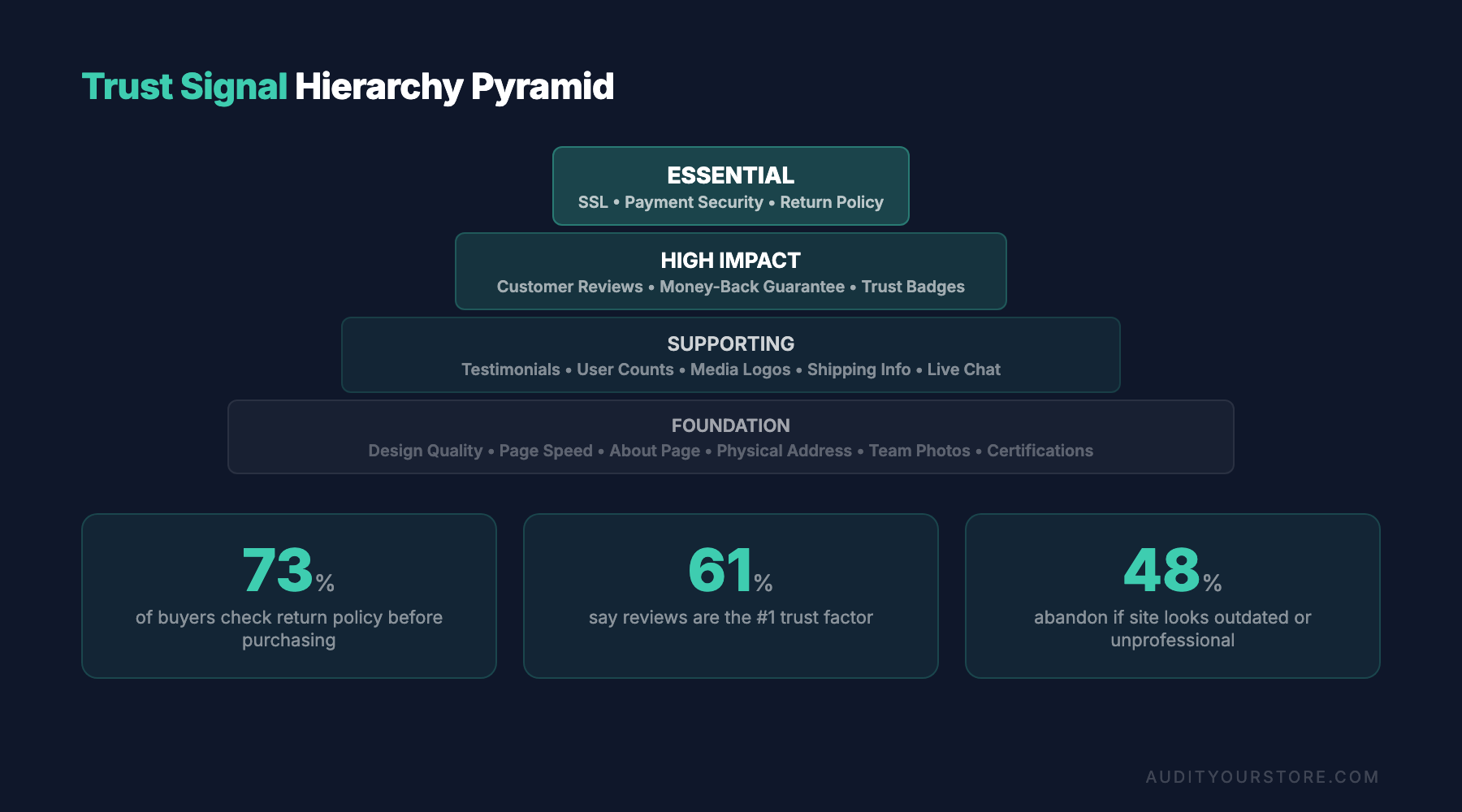
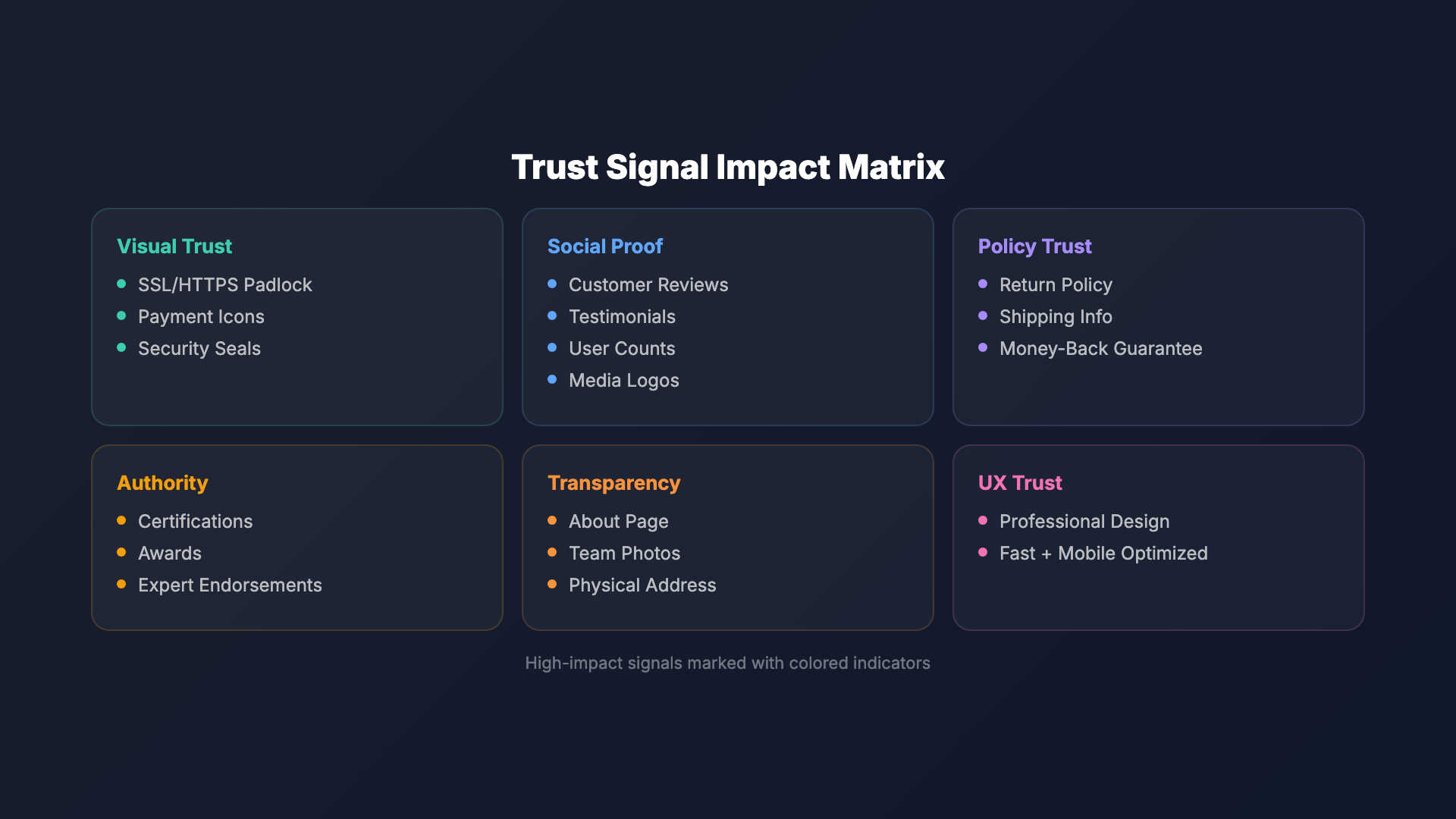
- The 18 trust signals span six categories: visual trust (SSL, payment icons, security seals), social proof (reviews, testimonials, user counts, media logos), policy trust (returns, shipping, guarantees), authority trust (certifications, awards, expert endorsements), transparency (about page, team photos, contact information), and UX trust (professional design, performance and mobile optimization).
- Context determines effectiveness. Match trust signals to the buyer journey stage — brand-level signals on the homepage, product-level signals on product pages, and risk-reduction signals at checkout.
- Authenticity is non-negotiable. Fake reviews, fabricated metrics, expired seals, and dishonest urgency tactics will destroy trust faster than you can build it. Every trust signal you display must be verifiable and current.
- Less is often more. A few well-placed, highly recognizable trust signals outperform a cluttered wall of badges. Prioritize quality and placement over quantity.
- Test and measure relentlessly. Trust signal effectiveness varies by industry, audience, and price point. Use A/B testing to identify which elements move the needle for your specific store.
- Performance is a trust signal. A fast, mobile-optimized, professionally designed site communicates competence before a single trust badge loads. Invest in your site’s technical foundation alongside its visible trust elements.
Start by auditing your current trust signal landscape. Identify gaps across all six categories, prioritize based on your most significant conversion barriers, and implement systematically. The brands that win in 2026 will not necessarily be the ones with the lowest prices or the biggest ad budgets — they will be the ones that make every visitor feel confident enough to click “Buy.”