

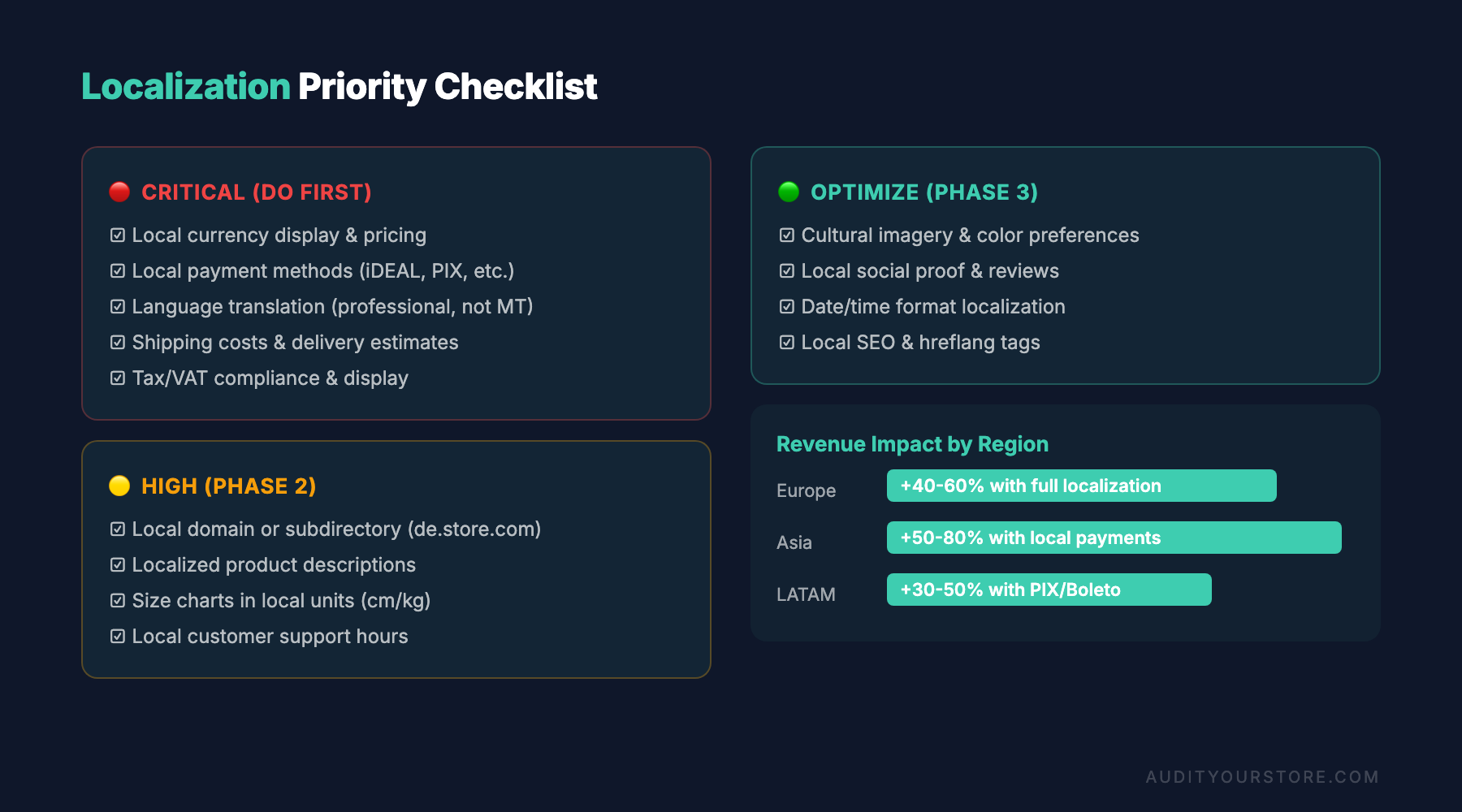
Expanding your ecommerce store into international markets is one of the most powerful growth levers available in 2026. But simply translating your homepage and shipping overseas is not a strategy — it is a recipe for abandoned carts and wasted ad spend. International ecommerce CRO is the discipline of systematically optimizing every touchpoint of your store so that shoppers in Berlin, Tokyo, Sao Paulo, and Dubai convert with the same confidence as your domestic customers.
The stakes are enormous. Cross-border ecommerce is projected to surpass $7.9 trillion globally by the end of 2026, yet average conversion rates for international traffic remain 30-60% lower than domestic traffic on most stores. The gap is not about product-market fit — it is about friction. Currency confusion, unfamiliar payment options, slow shipping expectations, and cultural mismatches silently erode trust at every stage of the funnel.
This guide walks you through the complete framework for localizing your store for global conversions — from currency and language to legal compliance, design preferences, and local trust signals. Whether you are entering your first international market or optimizing across a dozen, these strategies will help you close the gap between international traffic and international revenue.
Currency Localization: Eliminating the First Conversion Barrier
Nothing kills an international purchase faster than displaying prices in the wrong currency. Research from Baymard Institute consistently shows that unexpected currency conversions are among the top reasons for cart abandonment in cross-border transactions. When a shopper in Germany sees prices in USD, they immediately begin mental arithmetic — and mental arithmetic breeds hesitation.
| Region | Top Payment Methods | BNPL Adoption | COD Usage |
|---|---|---|---|
| 🇪🇺 Europe | Klarna, iDEAL, SEPA, Cards | 45% (Nordics) | Low |
| 🇺🇸 North America | Cards, Apple/Google Pay, PayPal | Growing (25%) | Rare |
| 🇬🇧 United Kingdom | Debit cards, Open Banking, PayPal | 30% | Rare |
| 🇨🇳 Asia Pacific | Alipay, WeChat Pay, UPI | Low | Varies |
| 🇧🇷 Latin America | PIX, Boleto, Installments | Low | 15-25% |
| 🇦🇪 Middle East | Mada, Apple Pay, Tabby | Growing | 40-60% |
Dynamic Currency Display
The gold standard for international ecommerce CRO is automatic currency detection based on the visitor’s IP geolocation, paired with the ability to manually override. Your store should:
- Auto-detect the visitor’s country and display prices in their local currency
- Provide a visible currency selector in the header — typically paired with a country/flag selector
- Display the converted price on product pages, collection pages, and throughout checkout
- Round prices to culturally appropriate endings (e.g., .99 in the US, .00 or .95 in many European markets)
- Show the original currency as a reference if the local price is a conversion estimate
Pricing Strategy Beyond Conversion
True localization goes beyond currency conversion. Brands like ASOS and Zara set independent price points per market rather than relying on real-time exchange rates. This allows them to account for local purchasing power, competitive positioning, and VAT-inclusive pricing norms. In the EU, for example, shoppers expect to see VAT included in the displayed price — showing a pre-tax price and adding VAT at checkout is a significant trust violation.
If you are running your store on WooCommerce, our WooCommerce audit guide covers multi-currency plugin configurations and common pitfalls in detail.
Language, Translation, and the UX of Multilingual Stores
Language localization is far more nuanced than running your site through a machine translation API. While tools like DeepL and Google Translate have improved dramatically, a purely automated translation creates subtle friction that erodes trust — awkward phrasing on CTAs, mistranslated size guides, or culturally inappropriate idioms in marketing copy.
A Tiered Translation Strategy
The most conversion-focused approach is a tiered system:
- Human translation for high-impact pages: Homepage, product pages, checkout flow, return policy, and FAQs. These are the pages where trust is built or broken.
- AI translation with human review for mid-tier content: Blog posts, category descriptions, and secondary informational pages.
- Automated translation for long-tail content: User reviews, community forums, and deep catalog descriptions where volume makes human translation impractical.
Language Switcher UX
The language selector itself is a conversion element. Best practices include:
- Display language names in their native script (e.g., “Deutsch” not “German,” “Japanese” not rendered in Roman characters)
- Place the selector in a consistent, predictable location — top right of the header is the global convention
- Never use flags alone to represent languages (Spanish is spoken in 20+ countries; Portuguese speakers in Brazil and Portugal have different expectations)
- Persist the language selection across sessions using cookies or account preferences
Nike handles this exceptionally well with their market selector that combines country, language, and currency into a single, intuitive modal. The experience feels intentional rather than bolted on — a critical distinction for brand perception.
Translating Beyond Words
Effective localization extends to date formats (DD/MM/YYYY vs. MM/DD/YYYY), number formatting (1.000,00 vs. 1,000.00), measurement units (centimeters vs. inches), and even color names. Overlooking these details signals to international shoppers that they are an afterthought, not a priority audience.
Local Payment Methods: Meeting Shoppers Where They Pay
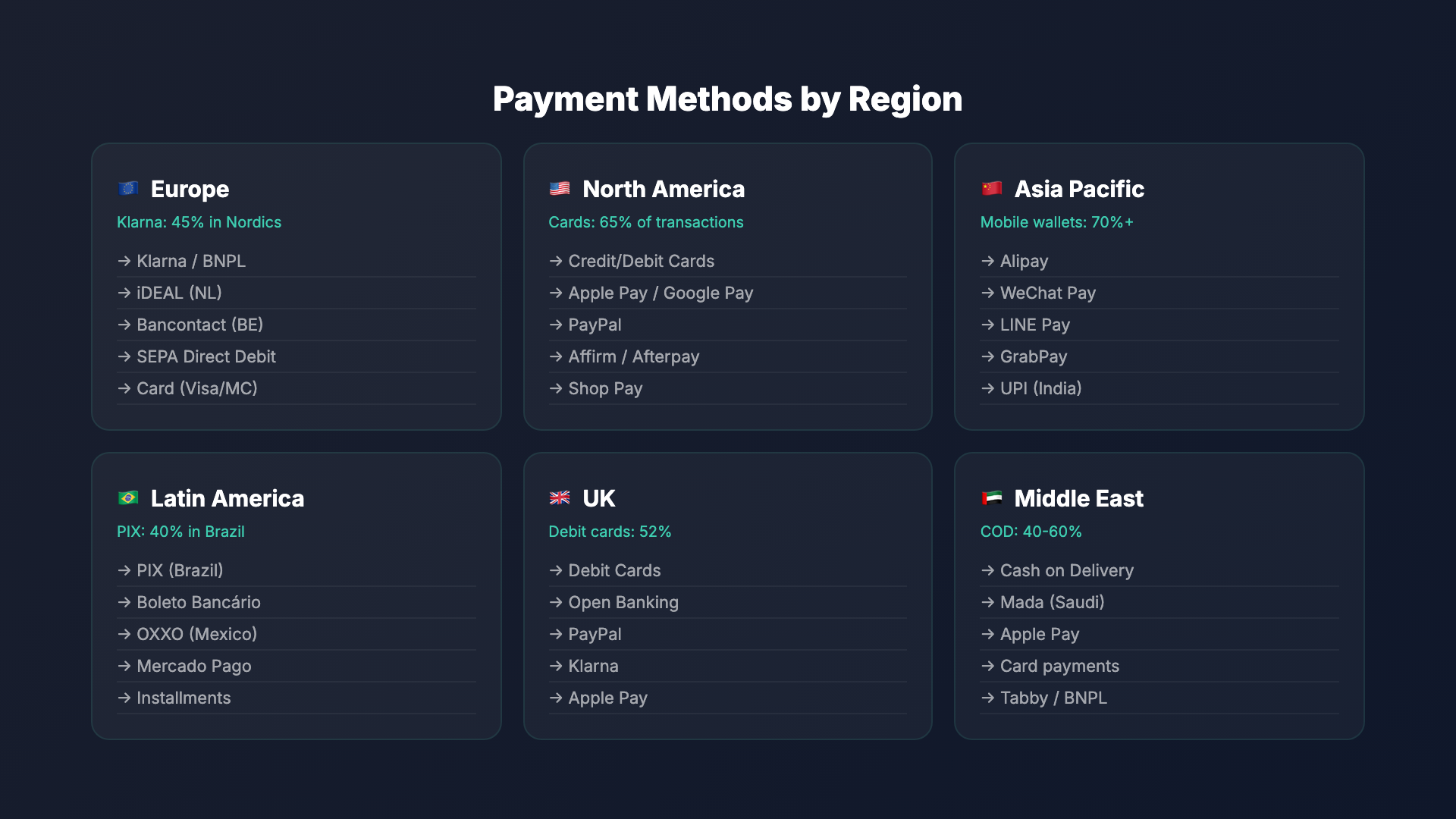
Payment preferences vary wildly by region, and failing to offer the locally dominant payment method is one of the most expensive mistakes in international ecommerce CRO. Credit cards may dominate in the US and UK, but they are a minority payment method in many of the world’s largest ecommerce markets.
Regional Payment Landscape in 2026
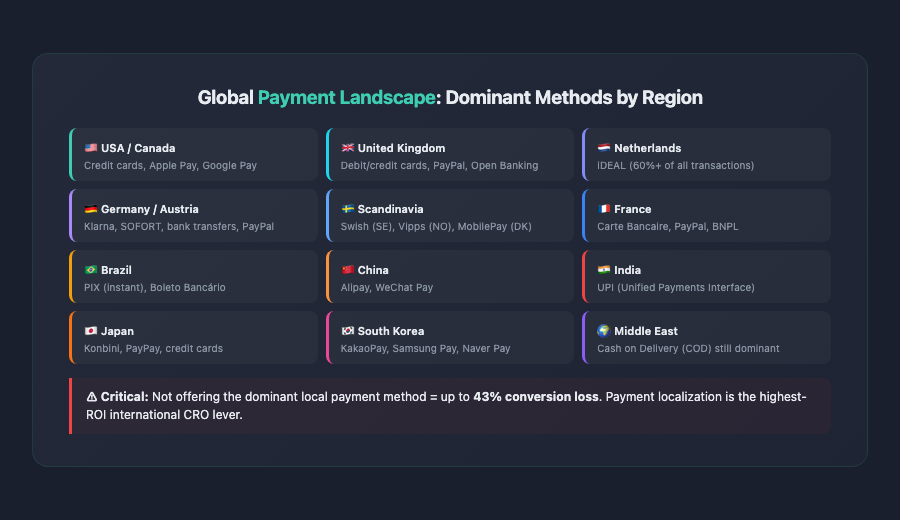
- Netherlands: iDEAL accounts for over 60% of online transactions. Dutch shoppers who do not see iDEAL at checkout will likely abandon.
- Germany & Austria: Klarna and direct bank transfers (SOFORT/Giropay) dominate. Germans are historically cautious about credit card usage, and buy-now-pay-later through Klarna has become the default for fashion and lifestyle purchases.
- China: Alipay and WeChat Pay process the vast majority of digital payments. Accepting neither is functionally equivalent to not accepting payment at all for Chinese consumers.
- Brazil: PIX, Brazil’s instant payment system launched by the central bank, has exploded to become the most popular payment method, surpassing credit cards. Boleto Bancario remains relevant for consumers without bank accounts.
- Scandinavia: Swish (Sweden), Vipps (Norway), and MobilePay (Denmark) are ubiquitous mobile payment solutions.
- India: UPI (Unified Payments Interface) has revolutionized digital payments, processing billions of transactions monthly.
- Japan: Konbini payments (convenience store payments) and PayPay remain widely used alongside credit cards.
Implementation Approach
Payment service providers like Adyen, Stripe, and Checkout.com offer unified APIs that support dozens of local payment methods. The CRO-optimized approach is to dynamically display payment options based on the shopper’s detected country — showing iDEAL prominently to Dutch visitors while surfacing Klarna for German shoppers. Burying local payment methods behind a “More options” dropdown defeats the purpose.
“When we added PIX as a primary payment option for our Brazilian customers — not hidden in a submenu, but displayed as the first option — our Brazil conversion rate increased by 43% within the first month.” — Head of International Growth, a mid-market fashion brand expanding into LATAM
Integrating your product page optimization strategy with localized payment messaging (e.g., displaying “Pay with Klarna” badges on product pages for German visitors) can reduce friction well before the checkout stage.
Shipping Expectations, Customs Transparency, and Delivery UX
Shipping is where many international expansion efforts fall apart. Domestic shoppers have been conditioned to expect fast, free (or cheap) delivery — and increasingly, international shoppers hold similar expectations for cross-border purchases. The challenge is that international shipping is inherently slower and more expensive, and the CRO objective is to set accurate expectations early and reduce post-click anxiety.
Region-Specific Shipping Expectations
- United States: 2-3 day delivery has become the baseline expectation, driven by Amazon Prime conditioning. Free shipping thresholds remain a powerful conversion lever.
- Europe (EU): 3-5 business day delivery is generally acceptable for cross-border EU shipments. DDP (Delivered Duty Paid) is increasingly expected — shoppers do not want surprise customs charges.
- United Kingdom (post-Brexit): UK shoppers have become acutely sensitive to unexpected customs duties and VAT charges on EU purchases. Transparent landed-cost calculators are essential.
- Australia & New Zealand: Shoppers are accustomed to longer delivery times (7-14 days for international orders) but have very low tolerance for hidden fees.
- Middle East: Cash on delivery (COD) remains a significant percentage of ecommerce transactions in Saudi Arabia and the UAE, and offering it can dramatically improve conversion.
DDP vs. DDU: A Critical CRO Decision
The choice between Delivered Duty Paid (DDP) and Delivered Duty Unpaid (DDU) shipping has a direct, measurable impact on conversion rates and return rates. Under DDU, the customer is responsible for import duties and taxes upon delivery — often resulting in refusal of the package. DDP shipping, where the merchant calculates and collects all duties and taxes at checkout, is the CRO-superior approach despite the added complexity.
Brands like Gymshark and Allbirds have invested heavily in DDP infrastructure for their key international markets, displaying the full landed cost at checkout. This transparency reduces post-purchase regret, lowers return rates, and increases repeat purchase rates from international customers.
Communicating Shipping Clearly
On product pages and in the cart, display estimated delivery dates (not just shipping speed) in the shopper’s local time zone. A message like “Estimated delivery: March 15-18” is far more effective than “Ships in 5-7 business days” for reducing uncertainty.
Cultural Differences in Design, Layout, and Content Preferences
Design preferences are not universal. What converts in Minneapolis may actively repel shoppers in Seoul or Riyadh. International ecommerce CRO requires understanding — and adapting to — cultural expectations around visual density, color, imagery, social proof, and information architecture.
Visual Density and Information Hierarchy
Western ecommerce design trends favor clean, minimalist layouts with generous whitespace. This aesthetic does not translate globally:
- East Asian markets (Japan, South Korea, China): Shoppers often prefer information-dense layouts. Japanese ecommerce sites like Rakuten pack product pages with detailed specifications, multiple imagery angles, extensive reviews, and promotional banners. What a Western designer might call “cluttered,” a Japanese shopper reads as “thorough and trustworthy.”
- Middle Eastern markets: RTL (right-to-left) layout is non-negotiable for Arabic-language stores. Beyond mirroring the layout, navigation patterns, reading flow, and even the direction of progress indicators must be flipped.
- Latin American markets: Vibrant colors, promotional urgency, and prominent social proof elements tend to outperform minimalist approaches. Brazilian ecommerce giant Magazine Luiza uses bold colors and countdown timers extensively.
RTL Layout Considerations
Supporting right-to-left languages (Arabic, Hebrew, Farsi) requires more than a CSS direction: rtl declaration. A comprehensive RTL implementation includes:
- Mirroring the entire layout — navigation, sidebars, breadcrumbs, and form fields
- Flipping directional icons (arrows, progress bars, carousels)
- Adjusting image compositions that have inherent directionality
- Ensuring embedded elements (maps, videos, third-party widgets) respect the RTL context
- Testing bidirectional text handling when RTL and LTR content (e.g., brand names, product codes) coexist
Amazon.ae (Amazon’s UAE store) is a strong reference for RTL ecommerce done right — every element, from the search bar to the checkout progress indicator, respects the right-to-left reading pattern.
Color and Imagery Sensitivities
Color carries different connotations across cultures. Red signifies luck and prosperity in China but can signal danger or debt in Western markets. White is associated with mourning in parts of East Asia. Green carries religious significance in Islamic cultures. While you do not need to redesign your entire brand palette for each market, be mindful of color choices in promotional banners, sale tags, and CTAs.
Product imagery should also reflect local audiences. Showing models that represent the local demographic — in clothing, skincare, and lifestyle categories especially — significantly improves relatability and conversion. H&M adapts their homepage hero imagery by market, featuring locally relevant models, seasonal context, and culturally appropriate styling.
Legal Compliance, Privacy, and Trust: GDPR, Cookie Consent, and Beyond
Legal compliance is not merely a box to check — it is a trust signal. Shoppers in regulated markets (particularly the EU) are increasingly sophisticated about data privacy, and your compliance posture directly impacts their willingness to transact.
GDPR and the European Data Landscape
If you sell to EU customers, GDPR compliance is mandatory. From a CRO perspective, the critical elements are:
- Cookie consent banners: Must offer genuine choice (not dark-patterned “Accept All” prominence). Poorly implemented consent banners — those that obscure content, slow page load, or make rejection difficult — actively harm conversion rates. The best implementations are clean, fast-loading overlays that respect the user’s choice without creating friction.
- Data collection transparency: Clearly explain what data you collect and why, particularly for email capture pop-ups and account creation flows.
- Right to deletion: Make account deletion straightforward — this builds trust even if few customers exercise it.
- Data processing agreements: Ensure all third-party tools (analytics, marketing pixels, chat widgets) are GDPR-compliant.
Regional Privacy Regulations
GDPR is the most prominent but far from the only relevant regulation:
- Brazil’s LGPD (Lei Geral de Protecao de Dados) mirrors GDPR in many respects and requires similar consent mechanisms.
- Japan’s APPI (Act on the Protection of Personal Information) was strengthened in recent amendments and requires specific handling of cross-border data transfers.
- California’s CCPA/CPRA requires “Do Not Sell My Personal Information” disclosures for California residents.
- China’s PIPL (Personal Information Protection Law) imposes strict data localization requirements and consent obligations.
A thorough CRO audit framework should include compliance checks for every market you actively target. Non-compliance is not just a legal risk — it is a conversion risk when savvy shoppers see red flags.
Local Trust Signals and Social Proof
Trust signals that resonate in one market may be meaningless in another. Effective international CRO requires localizing your credibility indicators:
- Germany: The Trusted Shops seal is one of the most recognized trust badges in German ecommerce. Displaying it can measurably increase conversion. Similarly, TUV certifications carry weight.
- France: The Fevad (Federation of Ecommerce and Distance Selling) badge signals legitimacy to French consumers.
- UK: Trustpilot reviews are widely consulted before purchase, and prominently displaying your Trustpilot score builds immediate credibility.
- Japan: Rakuten reviews and detailed product certifications carry more weight than Western review platforms.
- Brazil: Reclame Aqui is the dominant consumer complaint and reputation platform. A strong Reclame Aqui score is a powerful trust signal for Brazilian shoppers.
Beyond badges, localized social proof includes displaying reviews in the shopper’s language, showing purchase activity from their region (“42 people in Germany bought this today”), and featuring testimonials from customers in their market.
Technical Implementation: Hreflang, Geo-Targeting, and Site Architecture
The technical foundation of international ecommerce CRO determines whether search engines can properly index and serve your localized content — and whether shoppers land on the right version of your store.
Hreflang Implementation
Hreflang tags tell search engines which language and regional version of a page to serve to which audience. Proper implementation is essential for international SEO and, by extension, for ensuring that organic traffic arrives at the correctly localized experience. Key principles:
- Every localized page must include hreflang annotations pointing to all alternate versions, including a self-referencing tag
- Use the correct format:
hreflang="de-AT"for German language, Austria region — not justhreflang="de"if you have distinct pages for Germany and Austria - Include an
x-defaulthreflang for users who do not match any specific locale - Ensure reciprocal linking — if Page A references Page B, Page B must reference Page A
- Validate your implementation using Google Search Console’s International Targeting report and third-party tools like Ahrefs or Screaming Frog
Site Architecture Choices
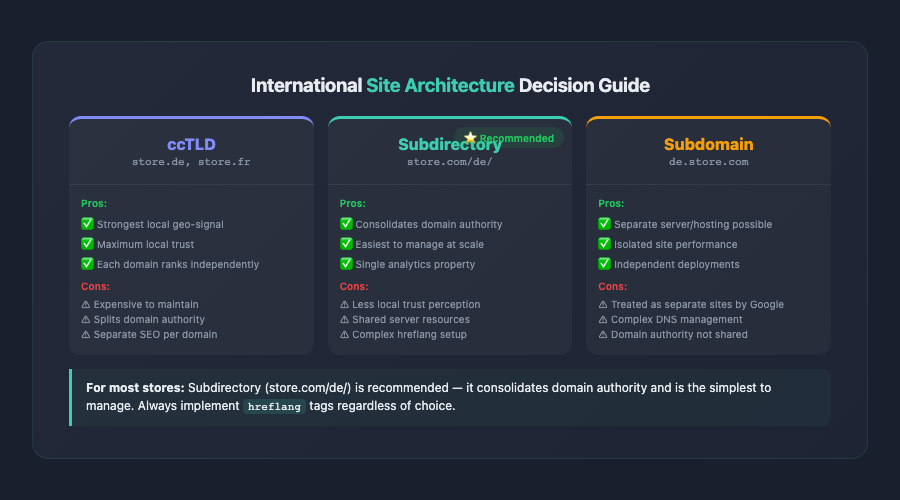
The three primary approaches to international site structure each have CRO implications:
- ccTLDs (e.g., store.de, store.fr): Strongest geo-targeting signal, highest trust with local audiences, but most expensive to maintain and hardest to consolidate domain authority.
- Subdirectories (e.g., store.com/de/, store.com/fr/): Consolidates domain authority, easiest to manage technically, and the most common choice for stores entering multiple markets. Shopify and most major platforms default to this structure.
- Subdomains (e.g., de.store.com): A middle ground, but Google treats subdomains somewhat independently, which can dilute SEO authority.
For most ecommerce stores, subdirectories are the CRO-optimal choice because they allow you to leverage your existing domain authority while creating fully localized experiences within each path.
Geo-Targeting and Redirection
Automatic geo-redirection — sending visitors to their local store version based on IP — is a double-edged sword. Hard redirects can frustrate users (especially those using VPNs or traveling) and cause SEO issues. The recommended approach is a geo-suggestion banner: detect the visitor’s location and display a non-intrusive prompt like “It looks like you are in France. Would you like to visit our French store?” This respects user autonomy while guiding them to the most conversion-optimized experience.
Apple executes this pattern flawlessly with their bottom-of-page geo-suggestion that is visible but never obstructive, allowing visitors to dismiss it or switch stores at their preference.
Local Customer Service and Post-Purchase Experience
The conversion funnel does not end at checkout. International CRO extends to the post-purchase experience, which directly impacts repeat purchase rates, lifetime value, and word-of-mouth in each market.
Localized Customer Support
Offering customer service in the shopper’s language is not optional for serious international expansion. Options range in cost and complexity:
- Native-language live chat: The highest-converting support channel, especially for pre-purchase questions. Tools like Zendesk and Gorgias now offer AI-assisted translation for real-time multilingual support.
- Localized email support: Ensure auto-responders, order confirmations, and shipping updates are sent in the customer’s language. Transactional emails are a massively underutilized CRO touchpoint.
- Local phone numbers: Displaying a local phone number (even if it routes to a central support team) is a powerful trust signal, particularly in markets like Germany and Japan where phone support is valued.
- Self-service in local language: Translated FAQs, size guides, return instructions, and help center articles reduce support volume and remove conversion barriers simultaneously.
Returns and Refund Localization
Return policies vary significantly in their conversion impact by market:
- EU consumers have a legal 14-day right of withdrawal for online purchases. Exceeding this minimum (e.g., offering 30-day returns) is a meaningful differentiator.
- Germany has the highest return rate in European ecommerce — sometimes exceeding 50% in fashion. German shoppers expect easy, free returns, and building this into your margin model is essential for the market.
- Offering local return addresses (through services like Global-e or return consolidation partners) dramatically reduces the friction and cost of international returns.
Localized Post-Purchase Communication
Order confirmation emails, shipping notifications, delivery updates, and review requests should all be localized — not just translated, but adapted. This includes local date and time formats, local carrier tracking links, and culturally appropriate tone. A post-purchase flow optimized for each market drives the repeat purchases that make international expansion profitable.
Applying our 276-point CRO checklist to each market individually will surface the specific friction points that aggregated analytics can miss. What works in your home market is your starting hypothesis — not your answer — for international audiences.
Key Takeaways
- Currency is the first gate: Auto-detect and display local currency with culturally appropriate price formatting. Consider market-specific pricing rather than simple exchange rate conversions.
- Translation is tiered, not binary: Invest in human translation for high-impact conversion pages (product pages, checkout, returns policy) and use AI-assisted translation for long-tail content.
- Payment localization is non-negotiable: iDEAL in the Netherlands, Klarna in Germany, PIX in Brazil, Alipay in China — if you do not offer the dominant local payment method, you are leaving enormous revenue on the table.
- Set shipping expectations early: Display estimated delivery dates (not just shipping speed), embrace DDP shipping to eliminate customs surprises, and consider local return addresses for high-return markets.
- Design is cultural: Minimalism is not universally preferred. Adapt visual density, color choices, and imagery to local expectations. RTL support for Arabic markets requires comprehensive layout mirroring, not just a CSS property.
- Compliance builds trust: GDPR, LGPD, PIPL — proper cookie consent and data handling are trust signals, not just legal obligations. Implement them cleanly to avoid conversion friction.
- Trust signals are local: Trusted Shops in Germany, Trustpilot in the UK, Reclame Aqui in Brazil. Display the credibility markers your target audience actually recognizes.
- Hreflang and site architecture matter: Proper technical implementation ensures shoppers and search engines find the right localized version. Subdirectories are the sweet spot for most stores.
- Geo-suggest, do not geo-redirect: Respect user autonomy with suggestion banners rather than hard redirects that frustrate VPN users and cause SEO complications.
- Localize the entire journey: From pre-purchase support in the local language to post-purchase emails with local date formats and carrier tracking — every touchpoint either builds or erodes trust with international shoppers.
International ecommerce CRO is not a single project — it is an ongoing practice of market-specific optimization. Start with your highest-potential market, build a fully localized experience using the strategies above, measure the conversion lift, and systematically expand from there. The brands winning globally in 2026 are those that make every shopper, in every market, feel like the store was built for them.